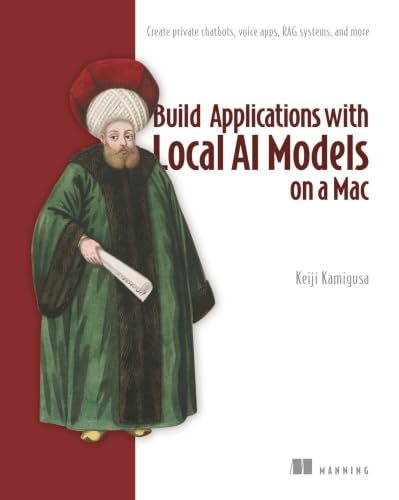
Home / Gothic & Horror / Build Applications with Local AI Models on a Mac: Create private chatbots, voice apps, RAG systems, and more
Gothic & Horror
Learn to build private, locally hosted AI applications on macOS with Keiji Kamigusa’s practical guide. Through hands-on projects, readers explore local language models, Python, Ollama, Streamlit, voic
Free forever. No account needed — your reading progress is saved in this browser.
Build useful AI applications on your Mac while keeping greater control over your data, models, and development environment. In Build Applications with Local AI Models on a Mac, Keiji Kamigusa introduces readers to the practical process of creating AI-powered tools that run on local hardware. The book begins with the foundations: navigating the macOS command line, installing Homebrew, setting up Python and a development environment, and downloading language models through Ollama. Readers then work toward a functional chatbot, learning how to connect a language model to a web interface using Streamlit and how to manage prompts, model settings, conversation history, and streaming responses. The projects progress into more advanced applications. Readers explore voice input and speech transcription with MLX Whisper, build a voice-enabled assistant, and learn how retrieval-augmented generation can connect an AI system to locally stored documents. The guide also introduces local AI agents, model selection, custom model configurations, and fine-tuning workflows. A central theme is the practical value of running AI on personal hardware: reducing dependence on external APIs, avoiding recurring service fees, and keeping sensitive information within a locally managed environment. The examples also introduce concepts such as context windows, temperature settings, and system prompts in an applied development context. Keiji Kamigusa+1 This book is intended for Mac users, developers, technical professionals, and curious hobbyists who want to understand and build with local AI. The publisher describes it as accessible to readers without prior programming or AI experience, making it a starting point for beginners as well as a practical reference for those expanding their AI development skills


 Real Novels