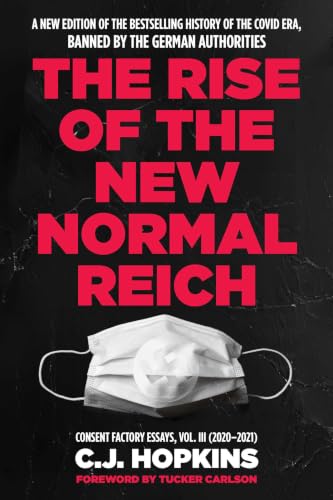
Home / Philosophy / The Rise of the New Normal Reich: Consent Factory Essays, Vol. III (2020–2021)
Philosophy
C. J. Hopkins examines the social and political changes that unfolded during the 2020–2021 Covid-19 period through a collection of essays, commentary, and satire. This volume explores public messaging
Free forever. No account needed — your reading progress is saved in this browser.
What happens when a society undergoes rapid change—and how should those changes be examined afterward? In The Rise of the New Normal Reich, writer and political satirist C. J. Hopkins brings together essays focused on the social and political developments of 2020 and 2021. The third volume of the Consent Factory Essays follows the emergence of what Hopkins calls the “New Normal.” Its subjects include pandemic-era public messaging, lockdowns, mask mandates, social distancing, censorship, restrictions on civil liberties, and the treatment of people who opposed or questioned prevailing policies. Hopkins approaches these events through political criticism, satire, and commentary on the relationship between institutions, media narratives, and individual freedoms. The collection includes essays such as “The Covidian Cult,” “The ‘Unvaccinated’ Question,” “The Criminalization of Dissent,” and “Manufacturing New Normal ‘Reality.’” Together, they provide a record of the author's perspective as events developed, while exploring broader questions about political power, public communication, social conformity, and dissent. Readers can expect an opinionated and provocative collection rather than a neutral textbook or conventional historical survey. The essays offer insight into Hopkins’s arguments and invite readers to examine the language, assumptions, and political interpretations surrounding the period. This book may interest readers of political essays, media criticism, civil-liberties debates, contemporary political satire, and alternative interpretations of recent history. Readers should approach it as the author's commentary and analysis, and consider its arguments alongside other historical accounts and perspectives.
 Real Novels