Home / Gothic & Horror / Evals for AI Engineers: Systematically Measuring and Improving AI Applications
Gothic & Horror
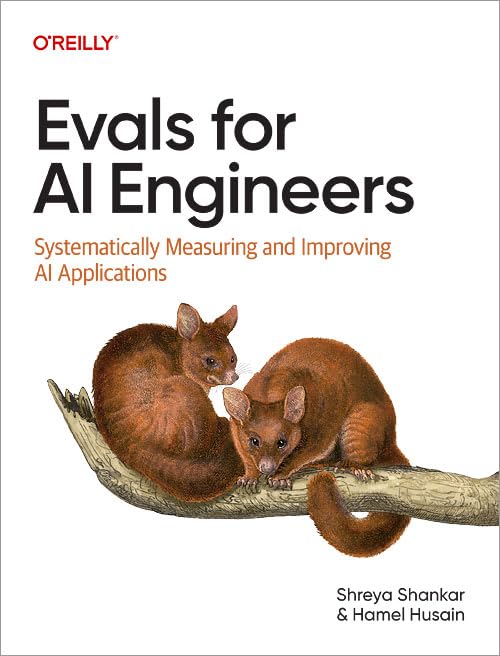
Evals for AI Engineers is a practical guide to testing, evaluating, and improving artificial intelligence applications, particularly those powered by large language models. Shreya Shankar and Hamel Hu
Free forever. No account needed — your reading progress is saved in this browser.
Building an AI application is only the beginning. Ensuring that it performs reliably, produces useful results, and improves over time requires a structured approach to testing and evaluation. Evals for AI Engineers: Systematically Measuring and Improving AI Applications by Shreya Shankar and Hamel Husain explores the engineering practices needed to measure and improve modern AI systems. The book focuses particularly on applications built with large language models (LLMs). Rather than relying on subjective impressions or occasional manual testing, readers learn how to establish repeatable evaluation processes that reveal weaknesses and guide meaningful improvements. A central topic is systematic error analysis. The authors explain how to identify recurring failure patterns, categorize problems, and prioritize the issues that have the greatest impact on application quality. Readers also explore how to develop representative test datasets using real-world examples and synthetic data. The guide examines several evaluation techniques, including code-based metrics, automated LLM-as-a-judge approaches, and human feedback. It also addresses evaluation pipelines, production monitoring, regression detection, and feedback loops that help teams maintain quality as their AI applications evolve. Beyond reliability, the book considers the practical trade-offs involved in deploying AI products, including performance, response latency, and operational costs. These concepts help engineering teams make informed decisions throughout the development and maintenance lifecycle. This book is particularly suitable for AI engineers, machine learning engineers, software developers, technical product managers, and engineering leaders working with generative AI and LLM-powered products. It is also useful for professionals who want to move from experimental prototypes toward measurable, dependable production systems. Through practical methods and engineering-focused guidance, readers can develop a more disciplined approach to building, testing, and maintaining trustworthy AI applications.






 Real Novels